Changdeokgung is a remarkable example of how residential and official structures were seamlessly integrated and harmoniously incorporated into their natural surroundings. Initially built as a second palace to the main Gyeongbokgung palace, it stood out from the main court due to its unique function and layout within the city.
Located at the foot of a mountain, the complex was planned to incorporate the topography, in accordance with the pungsu principles. The palace buildings were placed to the south, and an extensive garden named Biwon, also known as the Secret Garden, was incorporated towards the north. This adaptation to the terrain distinguished Changdeokgung from conventional palace designs.
The residential and official structures were constructed following traditional palace layout rules. They consist of three gates and three courts, including an Administrative, a royal, and a public audience court. The residential area located behind the administrative zone reflects the principles of summon Samjo (San Men Zhao) and ‘jeonjo Huchim (Qian Zhao Hou Qin)’, and is made from wood erected on stone platforms. The roofs are often fitted with tiles and feature a corbelled multi-bracket structure as well as ornamental carvings.
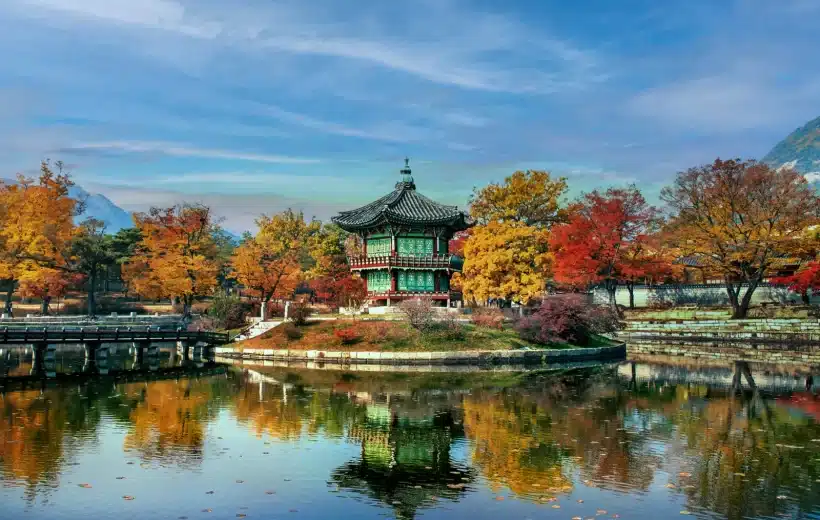
The garden, designed with a series of terraces, boasts lawns, flowers, trees, blooms, an enormous swimming pool, and pavilions set against a forest background. The garden is home to over 56,000 species of plants and trees, such as walnut, white oak zelkova, chestnut, plum, maple, hornbeam, yew, ginkgo, and pine.
Changdeokgung was the first palace to be rebuilt after the Japanese invasion in the 16th century, and for 250 years, it served as the principal residence of the dynasty. Its construction greatly influenced the evolution of Korean architecture, gardening, and landscape design, as well as related arts for many years. Changdeokgung reflects sophisticated architectural values that harmoniously blend with the beautiful landscape.